
India Post-quantum Cryptography (PQC) Market (2025-2030)

The India Post-quantum Cryptography (PQC) Market was valued at $2.4 Million in 2025 and projected to reach to $20.1 Million by 2030, representing a compound annual growth rate of 52.7%. India's post-quantum cryptography market is poised for exceptional growth, expanding from USD 2.4 million in 2025 to USD 20.1 million by 2030.


| Market Size in | USD 26.32 MN |
| Market Forecast in | |
| CAGR | |
| Forecast Period | |
| Units Considered | Value (USD MN) |
India Post-quantum Cryptography (PQC) Market Trends and Insights
- India's market growth significantly outpaces global trends, driven by increasing cybersecurity threats and government initiatives to strengthen digital infrastructure.
- India's technology sector and rising adoption of quantum-resistant encryption solutions across financial services, government, and IT sectors are accelerating market penetration. India's PQC market is benefiting from heightened awareness of quantum computing risks and regulatory pressures to implement advanced cryptographic standards.
- India's position as a global IT hub and growing investment in cybersecurity innovation are positioning the country as a key player in the Asia Pacific region.
- By 2030, India's market is expected to demonstrate the region's strongest growth trajectory, reflecting the nation's commitment to securing critical digital assets against emerging quantum threats..
Key Market Statistics
- CAGR (2025-2030) 52.7% CAGR
- Market Size, 2025 ~USD 2.4 Million
- Forecast, 2030 ~USD 20.1 Million
- Country India
India Post-quantum Cryptography (PQC) Market Overview
Explosive Growth Trajectory :
India's PQC market is expanding at 52.7% CAGR, significantly outpacing the global rate of 46.2%, reflecting the nation's accelerated digital transformation and cybersecurity investments.
Government-Driven Initiatives :
India's government is actively strengthening digital infrastructure through quantum-resistant encryption mandates, creating substantial demand across public and private sectors for PQC solutions.
Rising Cybersecurity Threats :
Escalating cyber threats targeting Indian enterprises and critical infrastructure are driving urgent adoption of quantum-safe cryptography to protect sensitive data and maintain regulatory compliance.
Tech Sector Leadership :
India's thriving technology sector, including IT services, fintech, and software companies, is rapidly adopting quantum-resistant encryption to safeguard intellectual property and customer data.
India Post-quantum Cryptography (PQC) Market Dynamics
- This remarkable 52.7% CAGR reflects India's strategic focus on quantum-safe infrastructure and heightened awareness of emerging cryptographic threats.
- Government initiatives, coupled with increasing cybersecurity investments from enterprises, are accelerating PQC adoption across banking, healthcare, and telecommunications sectors. The Indian market benefits from a large pool of technology talent, growing digital economy, and regulatory pressures to implement quantum-resistant standards.
- As organizations prepare for the quantum computing era, India's PQC market will attract significant investment from both domestic and international vendors, positioning the nation as a key growth hub in the Asia-Pacific region..
Market Ecosystem
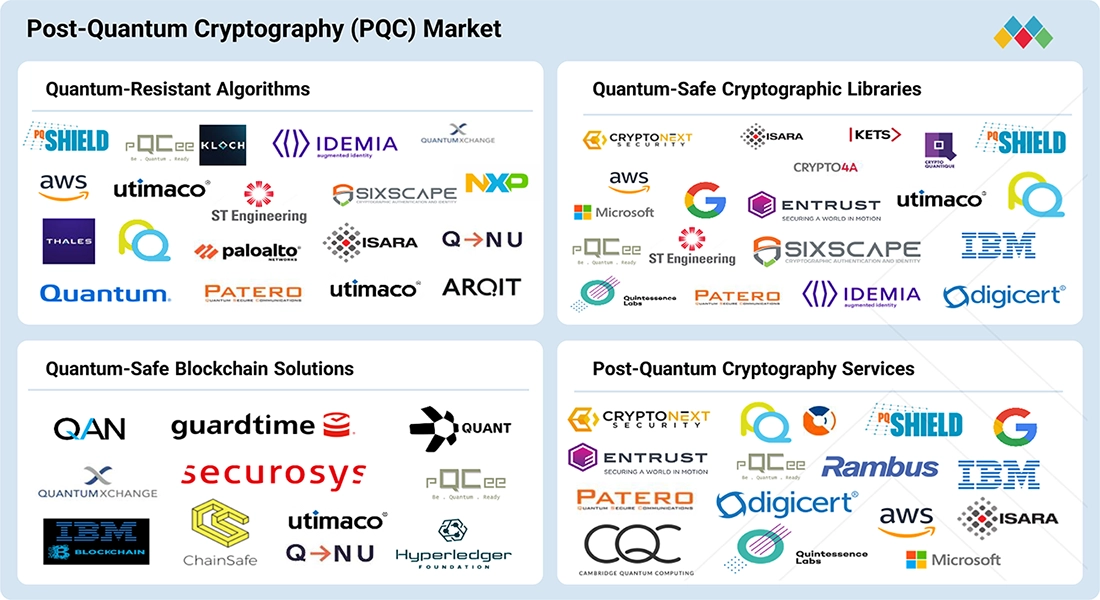
POST-QUANTUM CRYPTOGRAPHY MARKET: COMMERCIAL USE CASES ACROSS INDUSTRIES
| COMPANY | USE CASE DESCRIPTION | BENEFITS |
|---|---|---|
 |
A US federal agency deployed Quantum XChange’s Phio TX-EM quantum-safe security platform across 15 production sites, adding PQC to its existing Cisco network infrastructure without major hardware replacement. | Enabled quantum-safe protection across 15 sites, with individual site deployments reportedly completed in under 60 minutes and zero downtime for cryptographic algorithm changes. |
 |
Singapore-based Netrust integrated pQCee’s SafeQuard quantum-safe encryption into its nSignSG digital document-signing service, adding cryptographic protection for documents submitted for signing. | Strengthened document confidentiality against future quantum threats and extended quantum-safe encryption to an existing digital-signing workflow. |
 |
A multinational financial services company worked with Thales and Quantinuum to implement quantum-safe cryptography and to generate and securely store quantum-safe asymmetric keys using Thales Luna HSMs. | Enabled secure generation and scalable deployment of quantum-safe keys across existing IT infrastructure, with minimal disruption to established operations. |
 |
Newfold Digital selected DigiCert to modernize SSL/TLS certificate infrastructure supporting its Network Solutions Group and Bluehost Group, serving approximately six million customers, while preparing for the transition to PQC. | Supports modernization of certificate management at scale and prepares the hosting infrastructure for future post-quantum cryptographic migration. |
Logos and trademarks shown above are the property of their respective owners. Their use here is for informational and illustrative purposes only.
Related Ecosystem
Application Security
- Cloud Security
- Security Analytics
- Network Testing
- Web Application Security
- Biometric Security and Authentication System
- International Business Machines Corporation
- MICROSOFT CORPORATION
- Cisco Systems, Inc.
- PALO ALTO NETWORKS, INC
- Fortinet, Inc.
Cyber Security
- Cloud Security
- Biometric Systems
- Data Loss Prevention (DLP)
- Multi-Factor Authentication
- Security Analytics
- International Business Machines Corporation
- Cisco Systems, Inc.
- MITSUI BUSSAN SECURE DIRECTIONS INC
- MICROSOFT CORPORATION
- Allot Ltd.
Endpoint Security
- Cloud Security
- Security Analytics
- Multi-Factor Authentication
- Biometric Security and Authentication System
- Critical Communication Network
- International Business Machines Corporation
- MICROSOFT CORPORATION
- Cisco Systems, Inc.
- PALO ALTO NETWORKS, INC
- Fortinet, Inc.
Key Takeaways
- India's PQC market is projected to grow from USD 2.4 million (2025) to USD 20.1 million (2030) at a 52.7% CAGR, significantly exceeding global growth rates.
- India's financial services, government, and IT sectors are driving rapid adoption of quantum-resistant cryptographic solutions.
- India's status as a global IT hub and increasing cybersecurity investments position the country as a regional growth leader in Asia Pacific.
- India's regulatory environment and awareness of quantum computing threats are accelerating enterprise-level PQC implementation across critical infrastructure.
Post-quantum Cryptography (PQC) Market Report Scope
| Report Metric | Details |
|---|---|
| Base Year | 2025 |
| Fastest Growing Segment | MIGRATION SERVICES (Service) |
| Forecast Period | 2025–2030 |
| Growth Rate | CAGR of 46.2% from 2025 to 2030 |
| Largest Segment | SOLUTIONS (Offering) |
| Market Size Base Year (Billions) | ~USD 0.43 (2025) |
| Revenue Forecast (Billions) | ~USD 2.84 (2030) |
| Segments Covered | Offering, Solution, Service, Organization Size, Vertical, Deployment Mode, Type, Transmission Medium, Application |
India Post-quantum Cryptography (PQC) Market Report Segmentation
9 segment dimensions are covered across the global market.
By Offering
- Services
- Solutions
By Solution
- Quantum Communication Components
- Quantum Key Distribution (Qkd) Solutions
- Quantum Random Number Generators (Qrngs)
- Quantum-Resistant Algorithms
- Quantum-Resistant Encryption Solutions
- Quantum-Safe Authentication Solutions
- Quantum-Safe Blockchain Solutions
- Quantum-Safe Cryptographic Libraries
- Quantum-Safe Cryptographic Solutions
- Quantum-Safe Hardware
- Quantum-Safe Vpn, Email Services, And Messaging Systems
By Service
- Design, Implementation, And Consulting
- Migration Services
- Quantum Risk Assessment
By Organization Size
- Cloud
- Large Enterprises
- On-Premises
- Smes
By Vertical
- Academia & Research
- Aerospace
- Automotive
- Bfsi
- Energy & Utilities
- Government & Defense
- Healthcare
- It & Ites
- It & Telecommunication
- Other Verticals
- Retail & E-Commerce
By Deployment Mode
- Cloud
- On-Premises
By Type
- Long-Distance Qkd Systems
- Multiplexed Qkd Systems
By Transmission Medium
- Fiber-Optic Cable Transmission
- Satellite-Based Transmission
By Application
- Data Encryption
- Network Security
- Other Applications
- Secure Communication
INDIA: POST-QUANTUM CRYPTOGRAPHY (PQC) MARKET, BY VERTICAL, 2023–2030
| Segment | 2023 | 2024 | 2025 | 2026 | 2027 | 2028 | 2029 | 2030 | CAGR (%) |
|---|---|---|---|---|---|---|---|---|---|
| BFSI | 0.31 | 0.43 | 0.62 | 0.89 | 1.3 | 1.92 | 2.89 | 4.36 | 47.8 |
| GOVERNMENT & DEFENSE | 0.15 | 0.21 | 0.3 | 0.45 | 0.66 | 1 | 1.53 | 2.36 | 50.7 |
| HEALTHCARE | 0.09 | 0.13 | 0.2 | 0.31 | 0.49 | 0.77 | 1.23 | 1.99 | 58.1 |
| IT & ITES | 0.22 | 0.33 | 0.51 | 0.78 | 1.23 | 1.96 | 3.16 | 5.11 | 58.7 |
| OTHER VERTICALS | 0.28 | 0.4 | 0.58 | 0.85 | 1.25 | 1.87 | 2.82 | 4.37 | 49.8 |
| RETAIL & E-COMMERCE | 0.1 | 0.15 | 0.22 | 0.33 | 0.5 | 0.77 | 1.21 | 1.93 | 54.9 |
| TOTAL | 1.14 | 1.66 | 2.43 | 3.6 | 5.42 | 8.28 | 12.84 | 20.12 | 52.7 |
Target Audience
- Indian IT & Cybersecurity Companies : Understand market demand, competitive positioning, and growth opportunities to develop quantum-resistant solutions tailored for India's enterprise and government sectors.
- Global PQC Vendors & Solution Providers : Evaluate India's high-growth market potential, regulatory landscape, and customer segments to prioritize market entry strategies and localization efforts in this emerging hub.
- Indian Government & Regulatory Bodies : Access market intelligence to inform quantum-safe infrastructure policies, procurement standards, and digital security frameworks aligned with national cybersecurity objectives.
- Enterprise CISOs & IT Decision-Makers : Leverage India-specific market data to justify quantum cryptography investments, benchmark adoption timelines, and align security strategies with industry trends and compliance requirements.
- Investment & Private Equity Firms : Identify high-potential PQC startups and established players in India's rapidly expanding market to evaluate investment opportunities and portfolio company growth trajectories.
Key Companies in the India Post-quantum Cryptography (PQC) Market
| Company | HQ | Ownership | Strongest segments |
|---|---|---|---|
| NXP SEMICONDUCTORS | Netherlands | Public Company | Quantum-safe Hardware,Quantum-resistant Encryption Products,Cryptographic Libraries, |
| THALES | France | ||
| ST ENGINEERING | Singapore | ||
| ENTRUST | United States | Private Company | Quantum-resistant Encryption Products (PKI, certificates, secure email),Authentication (IdentityGuard, eID, ePassport, access),Cryptographic Libraries, |
| IBM | United States | Public Company | Quantum-safe Hardware,Quantum-resistant Encryption Products,Cryptographic Libraries, |
NXP SEMICONDUCTORS
NXP Semiconductors is a Dutch semiconductor company founded in 2006 that employs 32,169 people and operates as a publicly traded entity. The company designs and manufactures semiconductor products for various industries.
THALES
Thales is a French company operating in the defense, aerospace, and security sectors.
ST ENGINEERING
ST Engineering is a Singapore-based company operating in the engineering and technology sectors.
ENTRUST
Entrust is a United States-based private company founded in 1994 with 400 employees providing identity and security solutions.
IBM
IBM is a United States-based multinational technology company founded in 1911 that employs 264,300 people and operates as a publicly traded entity. The company provides hardware, software, and IT services across multiple industries.
Reasons to Buy this Report
- India-Specific Market Sizing : Access precise valuation data for India's PQC market with detailed 2025-2030 forecasts, enabling accurate investment decisions and resource allocation for India-focused business strategies.
- Competitive Landscape Analysis : Understand India's unique vendor ecosystem, local player positioning, and competitive dynamics specific to the Indian market to identify partnership and acquisition opportunities.
- Government Policy Insights : Gain detailed intelligence on India's quantum-safe infrastructure mandates, regulatory requirements, and government initiatives driving PQC adoption across sectors.
- Sector-Specific Adoption Trends : Analyze quantum cryptography adoption patterns across India's banking, fintech, healthcare, and telecommunications sectors to identify high-growth vertical opportunities.
- Regional Growth Benchmarking : Compare India's 52.7% CAGR against global trends and other Asia-Pacific markets to validate market potential and optimize go-to-market strategies for India expansion.
Frequently asked questions
What is the current size of India's post-quantum cryptography market?
India's PQC market was valued at USD 2.4 million in 2025 and is expected to grow to USD 20.1 million by 2030.
What is the projected growth rate for India's PQC market?
India's PQC market is projected to grow at a compound annual growth rate (CAGR) of 52.7% from 2025 to 2030.
Which sectors in India are driving PQC adoption?
India's financial services, government agencies, and IT sector are the primary drivers of PQC adoption, driven by cybersecurity requirements and regulatory compliance.
Why is India's PQC market growing faster than the global average?
India's rapid growth is driven by heightened cybersecurity awareness, government digital infrastructure initiatives, and the nation's position as a global IT hub with significant quantum computing threat exposure.
What factors are accelerating PQC implementation in India?
India's PQC adoption is accelerated by regulatory pressures, increasing quantum computing threats, government cybersecurity mandates, and enterprise-level security investments across critical infrastructure.
RESEARCH METHODOLOGY
Secondary research was conducted to gather information for this technical, market-oriented, commercial study of the PQC market. The next step involved validating these findings, assumptions, and sizing with industry experts across the value chain using primary research. We used top-down and bottom-up approaches to estimate the total market size. After that, the market breakup and data triangulation procedures were used to estimate the market size of the segments and subsegments of the PQC market.
Secondary Research
During the secondary research process, various secondary sources were consulted to identify and collect information relevant to the study. These sources included annual reports, press releases, investor presentations from PQC vendors, forums, certified publications, and whitepapers. The secondary research was mainly used to obtain key information about the industry’s supply chain, the total pool of key players, market classification and segmentation according to industry trends to the bottom-most level, regional markets, and key developments from both market- and technology-oriented perspectives, all of which were further validated by primary sources.
Primary Research
In the primary research process, various primary sources from both the supply and demand sides were interviewed to obtain qualitative and quantitative information for this report. Supply-side primary sources included industry experts such as chief executive officers (CEOs), vice presidents (VPs), marketing directors, technology and innovation directors, and other key executives from companies and organizations operating in the PQC market.
In the market engineering process, top-down and bottom-up approaches were extensively used, along with several data triangulation methods, to perform market estimation and forecasting for the overall market segments and subsegments listed in this report. We conducted extensive qualitative and quantitative analysis throughout the complete market engineering process to identify key information/insights for the report.
After completing the market engineering process (including calculations for market statistics, market breakups, market size estimations, market forecasts, and data triangulation), we conducted extensive primary research to gather information and verify & validate the critical numbers. The primary research was also conducted to identify the segmentation types, industry trends, competitive landscape of PQC market players, and key market dynamics, such as drivers, restraints, opportunities, challenges, industry trends, and key strategies.
The following is the breakdown of the primary study:
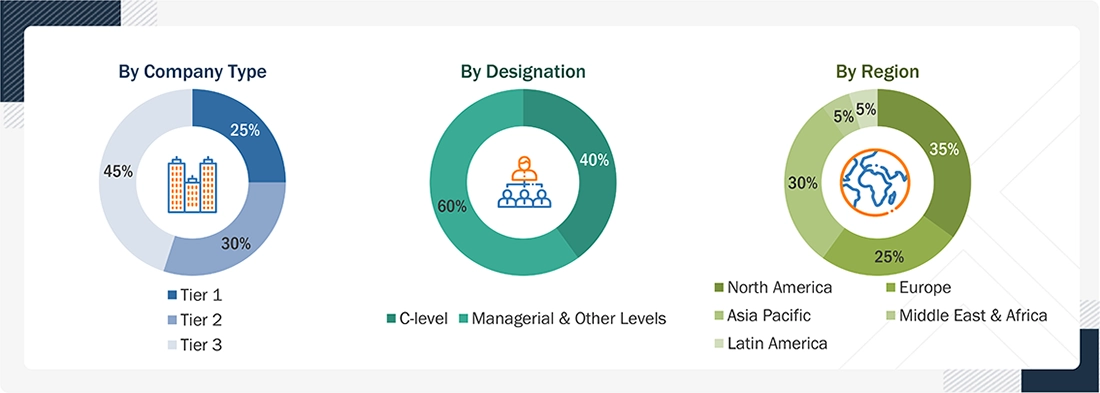
Note: Tier 1 companies have revenues above USD 10 billion; Tier 2 companies have revenues between USD 1 and 10 billion; and Tier 3 companies have revenues between USD 500 million and USD 1 billion. Other designations include sales, marketing, and product managers.
To know about the assumptions considered for the study, download the pdf brochure
Market Size Estimation
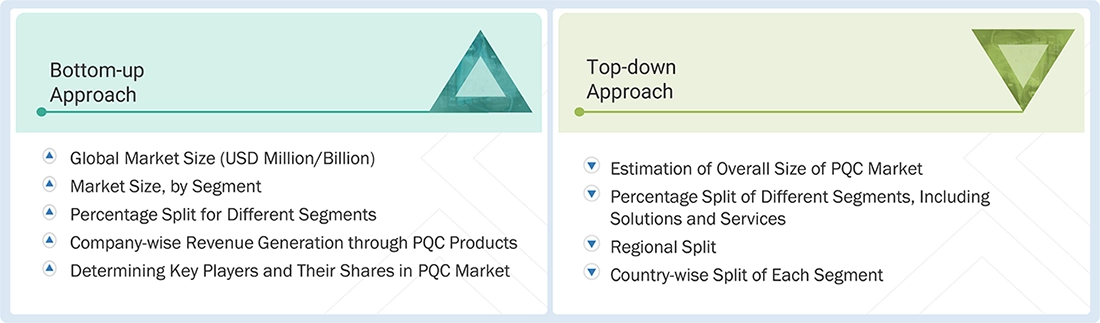
Top-down and bottom-up approaches were employed to estimate and validate the size of the PQC market, as well as the size of various dependent sub-segments within the overall PQC market. The research methodology used to estimate the market size includes the following details: critical players in the market were identified through secondary research, and their market shares in the respective regions were determined through primary and secondary research. This procedure involved reviewing the annual and financial reports of the top market players and conducting extensive interviews with key industry leaders, including CEOs, VPs, directors, and marketing executives, to gather insights.
We determined all percentage splits and breakdowns using secondary sources and verified them through primary sources. This study accounted for all parameters that affect the market, reviewed them in detail, verified them through primary research, and analyzed them to produce final quantitative and qualitative data. This data was consolidated with detailed inputs and analysis from MarketsandMarkets.
Post-Quantum Cryptography Market: Top-Down and Bottom-Up Approach
Data Triangulation
The market was split into several segments and subsegments after arriving at the overall market size using the market size estimation processes explained above. The data triangulation and market breakup procedures were employed, wherever applicable, to complete the overall market engineering process and arrive at the exact statistics of each market segment and subsegment. The data was triangulated by studying various factors and trends from both the demand and supply sides.
Market Definition
The post-quantum cryptography market comprises products and services designed to protect digital information, communications, and systems against attacks from both conventional and quantum computers. The market includes quantum-safe hardware, cryptographic software and libraries, tools for cryptographic discovery and migration management, quantum-safe public key infrastructure (PKI), digital signatures, identity security, key management, network security, and application and device security solutions. It also encompasses consulting, implementation, migration, and quantum risk assessment services that help organizations identify vulnerable cryptographic assets and transition to quantum-resistant algorithms. Market adoption is driven by the need to modernize existing cryptographic infrastructure and maintain data confidentiality, authentication, and digital trust as quantum computing advances.
Key Stakeholders
- CIOs, CTOs & Chief Information Security Officers (CISOs)
- Cryptography Engineers, Researchers & Security Architects
- Cryptographic Discovery, Risk Assessment & Migration Teams
- Quantum-Safe Hardware, Software & Cryptographic Library Vendors
- PKI, Digital Signature, Key Management & Identity Security Providers
- Network Security, Application Security & Embedded Device Security Providers
- PQC Consultants, System Integrators & Professional Services Providers
- Cloud Service Providers & Enterprise IT Infrastructure Teams
- Government Agencies, Cryptographic Standards Organizations & Regulators
- Investors, Venture Capital Firms & Strategic Technology Partners
Report Objectives
- To define, describe, and forecast the PQC market based on offering, organization size, vertical, and region
- To provide detailed information on major factors, such as drivers, opportunities, restraints, and challenges, influencing market growth
- To forecast the size of market segments across five main regions: North America, Europe, Asia Pacific, Middle East & Africa, and Latin America
- To analyze subsegments of the market with respect to individual growth trends, prospects, and contributions to the overall market
- To profile key market players and comprehensively analyze their market shares and core competencies
- To map the competitive intelligence based on company profiles, key player strategies, and game-changing developments, such as product enhancements/launches, collaborations, and acquisitions
- To track and analyze the competitive developments, such as product enhancements/launches, acquisitions, partnerships, and collaborations, in the PQC market globally
Available customizations:
With the given market data, MarketsandMarkets offers customizations based on company-specific needs. The following customization options are available for the report:
Geographic Analysis
-
Further breakdown of the Asia Pacific market by country, showing contributions to the regional market size.
-
Further breakdown of the North American market by country, showing each country's contribution to the regional market size.
-
Further breakdown of the Latin American market by country, showing each country's contribution to the regional market size.
-
Further breakdown of the Middle East & Africa market by country, showing each country's contribution to the regional market size.
- Further breakdown of the European market by country, showing each country's contribution to the regional market size.
Company Information
-
Detailed analysis and profiling of additional market players (up to 5)
Get the Full Post-quantum Cryptography (PQC) Market Report
Full forecast, segment splits, and company analysis for all Post-quantum Cryptography (PQC) Market.
- US Post-quantum Cryptography (PQC) Market
- UK Post-quantum Cryptography (PQC) Market
- Germany Post-quantum Cryptography (PQC) Market
- France Post-quantum Cryptography (PQC) Market
- China Post-quantum Cryptography (PQC) Market
- Japan Post-quantum Cryptography (PQC) Market
- Brazil Post-quantum Cryptography (PQC) Market
- Mexico Post-quantum Cryptography (PQC) Market
- Rest Of Europe Post-quantum Cryptography (PQC) Market
- Rest Of Asia Pacific Post-quantum Cryptography (PQC) Market
- Rest Of Latin America Post-quantum Cryptography (PQC) Market
- Canada Post-quantum Cryptography (PQC) Market
Need a Tailored Report?
Customize this report to your needs
Get 10% FREE Customization
Customize This Report
